Stand Banner Mockup: A Designer's Guide to Professional Display
Every designer, marketer, or small business owner has been there. You’ve spent hours perfecting a logo, a tagline, or a promotional graphic for a roll-up banner. The colors are perfect, the layout is balanced, and the message is clear. But when it comes to presenting the final design to a client or showcasing it in your portfolio, a flat, lifeless image on a screen just doesn’t do it justice. You need context. You need scale. You need to show how that design will live and breathe in the real world. This is where a high-quality mockup transforms from a nice-to-have into an essential design asset.
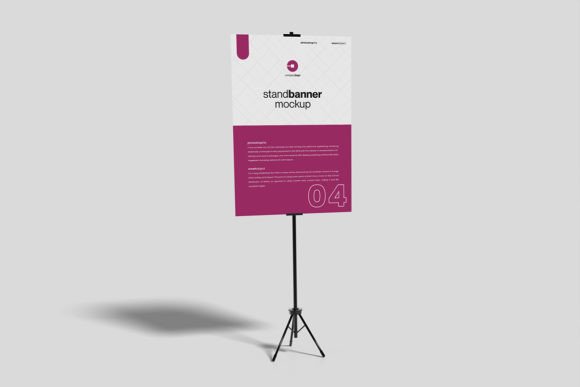
A Stand Banner Mockup is precisely that tool. It’s a digitally crafted, photorealistic 3D scene that replicates a physical banner stand. Think of it as a blank canvas for your artwork, built with layers of realism—subtle shadows, ambient lighting, and accurate perspective. The visual personality of a well-made mockup is clean, credible, and versatile. It doesn’t scream for attention; instead, it provides a neutral, professional stage that lets your actual design take the spotlight. Its appeal lies in its ability to bridge the gap between a digital file and a tangible product, giving your work immediate weight and presence.
Where This Mockup Elevates Your Work
The applications for a Stand Banner Mockup are surprisingly broad, touching nearly every corner of the creative and commercial landscape. For designers and agencies, it’s the cornerstone of a polished portfolio presentation. Showing a client their new branding on a stand in a realistic office or trade show setting is infinitely more persuasive than a JPEG on a white background. It demonstrates foresight and an understanding of the final output.
Entrepreneurs and small business owners will find it invaluable for pre-production planning. Before investing in printing costs, you can visualize your event signage, in-store promotion, or trade show display. This allows for crucial last-minute tweaks to typography, imagery, or hierarchy that are much harder to see in a flat file. Marketers can use the mockup to create compelling social media graphics or website visuals that announce an upcoming sale or event, generating excitement with a tangible, professional-looking asset. Even bloggers and content creators can use it to illustrate articles about branding, design, or event planning with authentic, high-quality imagery.
Affecting Brand Perception and Audience Engagement
The true power of using a tool like the Stand Banner Mockup is its influence on perception. Presentation directly shapes how an audience—and more importantly, a client or customer—perives the professionalism and quality of a brand. A design shown in a crisp, 3D environment signals that you care about details and understand execution. It builds trust. This consistency in presentation across your portfolio or marketing materials strengthens brand identity, making your work more recognizable and memorable.
From a practical standpoint, it enhances visual hierarchy. Placing your design within a mockup allows you to test readability and focal points in a simulated real-world environment. Does the headline still grab attention from a few feet away? Is the call-to-action clear? These are critical questions a flat file can’t answer, but a Stand Banner Mockup can help you evaluate.
Practical Guidance for Choosing and Using Your Mockup
When selecting a mockup file, look for the technical features that make your life easier. The item described is a perfect example of what to seek out. It’s available in PSD Photoshop format, which is the industry standard, and crucially, it uses smart-object features. This is non-negotiable for efficiency. Smart objects allow you to replace the placeholder design with your own artwork in seconds, often with just a double-click and a paste. The design automatically conforms to the perspective and lighting of the mockup scene.
Evaluate the file’s specifications. A high resolution like 3000x2000 px at 300 dpi ensures your final presentation images are sharp and suitable for both web and high-quality print use. The ability to change the background color is a significant bonus, allowing you to match the mockup to your brand’s color scheme or the environment you’re simulating. Always review the included help file; a good creator will provide clear instructions to get you started immediately.
Think about font pairing and overall design context when using the mockup. If your banner features a bold, modern sans serif font for the headline, you might pair it with a clean, legible serif for body text in supporting materials. The mockup lets you test these combinations in a realistic setting. Consider the style—is your brand more suited to a sleek, minimalist stand or a more vibrant, dynamic setting? Choose a mockup that aligns with your project’s personality.
Finally, remember the licensing note. The photos used in the preview are for illustration only. This is standard and important. It means the mockup file itself is what you’re using, and you are free to insert your own designs. This is a commercial font and design asset in the sense that you can use the resulting mockup images for client work, portfolios, and marketing, but you cannot redistribute the original template file. It’s a tool for creation, not a product for resale.
Investing in a quality Stand Banner Mockup is investing in the perceived value of your work. It’s a practical, time-saving asset that elevates presentations, aids in decision-making, and ultimately helps your designs and your brand make a stronger, more professional impact. It’s the difference between showing a sketch and showing a solution.