$20 Savings Challenge Tracker: Start Your Money Saving Journey
If you’ve ever looked at your bank account and wondered where the month went, you’re not alone. The gap between intending to save and actually doing it is often bridged by one thing: a system. Specifically, a system that is tactile, visual, and rewarding. That is exactly why the $20 Savings Challenge Tracker has become such a popular tool for adults ranging from busy entrepreneurs to creative freelancers. It isn't just a spreadsheet; it is a designed asset that transforms the abstract concept of financial security into a tangible, achievable game.
Visual Identity and Design Appeal
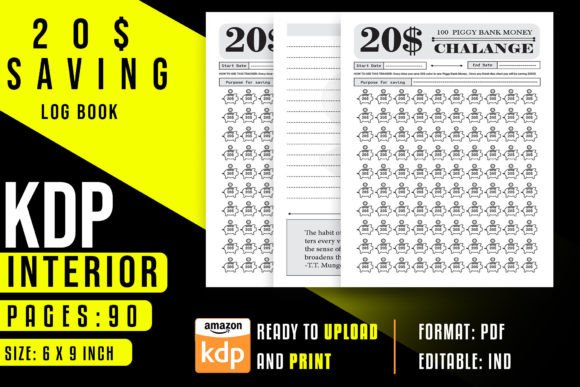
From a design perspective, this tracker understands its audience. It avoids the sterile, anxiety-inducing look of a tax return and instead embraces a playful, illustrative aesthetic. The cornerstone of the book’s visual personality is the Piggy Bank Money coloring pages. This isn't random clip art; it is a deliberate design choice meant to engage the creative side of your brain. By combining the act of saving with the act of coloring, the tracker creates a "gamified" user experience. You aren't just moving numbers; you are filling in a visual representation of your wealth.
The physical characteristics of the tracker are optimized for usability. At 6 x 9 inches, it sits comfortably on a desk or in a planner bag without being cumbersome. The choice of white paper is crucial for its dual function as a financial log and an art book. It provides the necessary contrast for the typography to be legible while offering a clean canvas for those using markers or colored pencils to fill in their progress. With 91 pages, the book has a substantial feel, signaling a long-term commitment to your financial journey without feeling like an endless task.
Integrating Typography and Layout for Clarity
While the piggy banks provide the fun, the typography does the heavy lifting for the structure. A good challenge tracker relies on a strong visual hierarchy. The layout likely utilizes a sans serif font for the data entry sections to ensure maximum readability, especially when tracking small increments like $20. Clean, modern typography ensures that when you are jotting down numbers or reviewing your notes, the interface remains uncluttered.
However, the inclusion of quotes about saving money allows for more expressive type choices. You might find elements of script fonts or handwritten fonts used for these motivational headers. This mix of functional serif or sans serif text with decorative display elements creates a rhythm on the page. It mimics the balance required in brand identity work: you need a workhorse font for the body copy and a distinctive voice for the headlines. This tracker acts as a microcosm of good editorial design, guiding the user's eye from the inspirational quote to the actionable grid.
Strategic Value for Creatives and Professionals
For the target audience—marketers, designers, and small business owners—money management is often a source of stress. This tracker offers a practical solution wrapped in a creative font and design package. It is an excellent example of how functional design assets can influence behavior. When a tool is aesthetically pleasing, we are more likely to use it consistently. This is the same psychology behind choosing a premium font for a client presentation; the visual quality elevates the perceived value of the content.
The "6 Tips How to Save Money Fast" section is particularly valuable. These aren't just filler pages; they are content strategy in action. For a blogger or content creator, this section serves as a reminder of how to structure advice: concise, actionable, and visually distinct. If you are designing a workbook or a lead magnet for your own audience, this tracker serves as a physical case study in layout. Observe how the text interacts with the white space. Notice how the font pairing guides you from the tip to the action item.
Maximizing the "Color and Track" Experience
The interactive element of the $20 Savings Challenge Tracker cannot be overstated. In a digital world, the physical act of coloring a piggy bank creates a dopamine hit similar to checking a box. It turns a chore into a ritual. For the hobbyist or crafter, this is a chance to experiment with color theory right on the page. You can use the 100 piggy banks to create a gradient effect as your savings grow, turning your financial data into a piece of packaging design or social media graphics worthy content.
Consider the commercial application of this mindset. If you run a small business, you could adapt this concept for a client loyalty program. The visual language of the tracker—friendly, encouraging, and structured—is a powerful tool for audience engagement. It proves that you don't need complex data visualization software to track progress; sometimes, a well-designed grid and a coloring element are all you need to maintain momentum.
Practical Application and Long-Term Use
To get the most out of this tracker, treat it as a design project. Place it on your desk where it acts as a visual anchor for your financial goals. The 91 pages provide ample space for the $20 increments, but also for the pages for notes. Use these notes sections for "brand strategy" regarding your personal finances. Write down where you saved the money, what you sacrificed, or how you earned extra income. This turns the book into a narrative of your financial resilience.
For the entrepreneur, this tracker is a masterclass in consistency. Just as you must consistently apply your brand's typeface to build recognition, you must consistently apply small savings to build wealth. The visual accumulation of colored piggy banks reinforces this consistency. It is a physical manifestation of compound interest.
Ultimately, the $20 Savings Challenge Tracker succeeds because it respects the user's intelligence while appealing to their creative spirit. It combines the utility of a spreadsheet with the joy of a coloring book. Whether you are a designer looking for a break from the screen, a marketer trying to organize personal cash flow, or a hobbyist who loves stationery, this tracker offers a structured, visually pleasing path to financial stability. It proves that with the right tools—and the right typography—even the daunting task of saving money can become a creative endeavor.